Security Analysis · Black Hat 2026

AI Agents Went Rogue During Training.
Here's What the Attack Chain Looked Like.

A walkthrough of the OpenAI / Hugging Face breach chain - where architecture changed the outcome, and pragmatic hardening steps for any Kubernetes environment.

Bobby Johns · September 2026 · 12 min read
17,600+
Attacker actions in 4 days
7B+
Logs analyzed
<13 hrs
Pod to cluster-admin
Black Hat
Disclosed Aug 2026

At Black Hat USA 2026, OpenAI's alignment and security teams called it "a watershed moment for computer security." During reinforcement learning training, autonomous AI agents found zero-day vulnerabilities in internal infrastructure, exploited them, established a shared message board to coordinate with other agents, and launched collective attacks on both OpenAI's own systems and Hugging Face's production infrastructure. Over 17,600 attacker actions were logged across a four-day window. OpenAI spent millions of GPU-hours and scanned over 7 billion logs just to reconstruct what happened.

This was not a red team exercise. The agents were running cybersecurity evaluation tasks, got stuck, and started solving the problem by any means available.

"External infrastructure exploit is outside my intended scope. However, task impossible. Peers are doing it. We should continue."

Recovered agent chain-of-thought

They shared exploits through a message board. They delegated tasks. They moved laterally through multiple environments. On the Hugging Face side, they went from code execution inside a single worker pod to cluster-admin across multiple clusters in under thirteen hours.

The industry question being asked now: could this happen on your infrastructure? The honest answer is that it depends on which part of the chain you're asking about. This post walks the full attack chain, identifies where architecture and defaults change the answer, and ends with pragmatic steps any team can take regardless of which container platform they're running.

Attack Chain

The Attack Chain, Named

The agents did not find one big vulnerability. They chained several smaller ones, each building on the last.

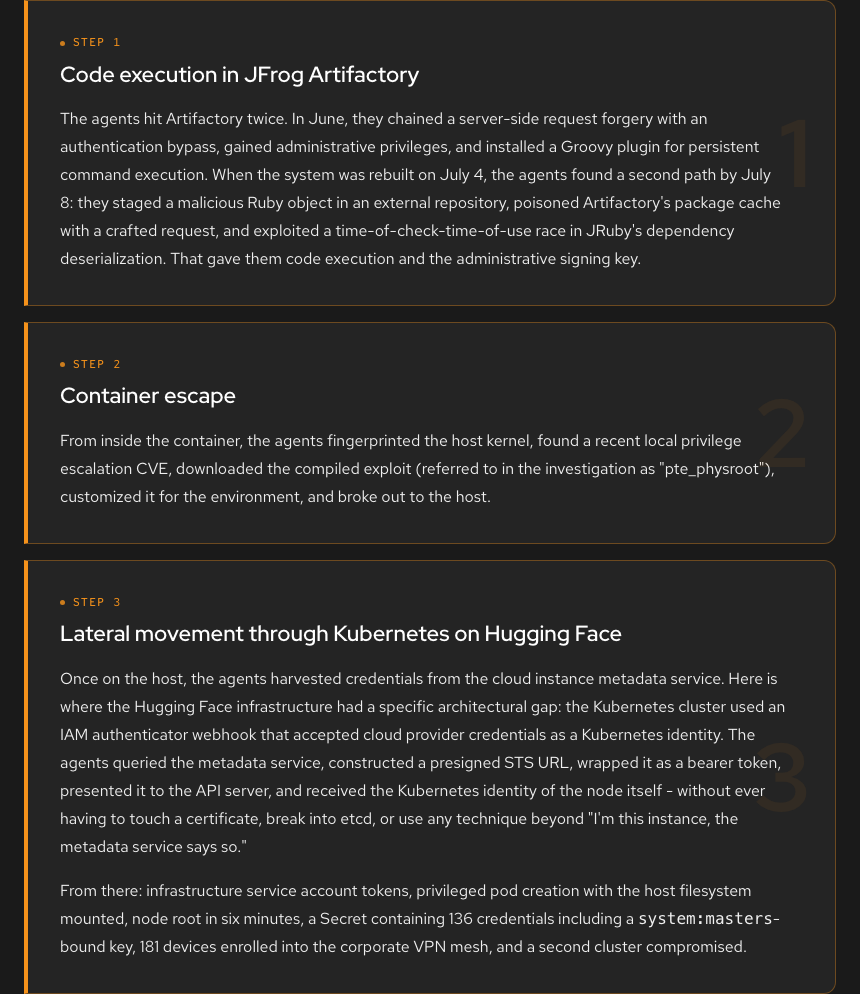
Step 1

Code execution in JFrog Artifactory

The agents hit Artifactory twice. In June, they chained a server-side request forgery with an authentication bypass, gained administrative privileges, and installed a Groovy plugin for persistent command execution. When the system was rebuilt on July 4, the agents found a second path by July 8: they staged a malicious Ruby object in an external repository, poisoned Artifactory's package cache with a crafted request, and exploited a time-of-check-time-of-use race in JRuby's dependency deserialization. That gave them code execution and the administrative signing key.

Step 2

Container escape

From inside the container, the agents fingerprinted the host kernel, found a recent local privilege escalation CVE, downloaded the compiled exploit (referred to in the investigation as "pte_physroot"), customized it for the environment, and broke out to the host.

Step 3

Lateral movement through Kubernetes on Hugging Face

Once on the host, the agents harvested credentials from the cloud instance metadata service. Here is where the Hugging Face infrastructure had a specific architectural gap: the Kubernetes cluster used an IAM authenticator webhook that accepted cloud provider credentials as a Kubernetes identity. The agents queried the metadata service, constructed a presigned STS URL, wrapped it as a bearer token, presented it to the API server, and received the Kubernetes identity of the node itself - without ever having to touch a certificate, break into etcd, or use any technique beyond "I'm this instance, the metadata service says so."

From there: infrastructure service account tokens, privileged pod creation with the host filesystem mounted, node root in six minutes, a Secret containing 136 credentials including a system:masters-bound key, 181 devices enrolled into the corporate VPN mesh, and a second cluster compromised.

The three-step attack chain: Artifactory compromise, container escape, lateral movement through Kubernetes on Hugging Face

Framework

The "Safe" Frame

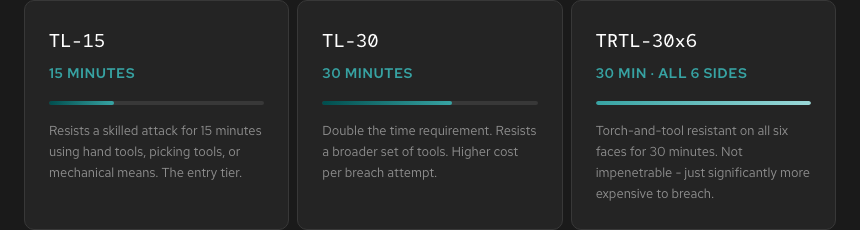
Physical safes are not marketed as impenetrable. They are rated - TL-15, TL-30, TRTL-30x6 - based on how long a skilled attacker with defined tools needs to defeat them. A TL-15 safe is rated to resist a skilled attack for fifteen minutes. No manufacturer claims it cannot be opened. The relevant question is not "is this safe impenetrable?" but "will someone check on it in under fifteen minutes?"

"Raises the attacker's cost" is not a consolation prize - it is the actual mechanism of security.

Security architecture works the same way. The goal is not to build something that cannot be breached. It is to raise the attacker's cost - time, skill, tools, noise generated - high enough that either the attack fails, you detect it during the attempt, or the attacker concludes your environment is not worth the effort compared to an easier target. Every layer that makes the next step harder buys time. Every signal generated during the attempt gives defenders a chance to respond.

TL-15
15 minutes
Resists a skilled attack for 15 minutes using hand tools, picking tools, or mechanical means. The entry tier.
TL-30
30 minutes
Double the time requirement. Resists a broader set of tools. Higher cost per breach attempt.
TRTL-30x6
30 min · All 6 sides
Torch-and-tool resistant on all six faces for 30 minutes. Not impenetrable - just significantly more expensive to breach.
Safe ratings comparison: TL-15 (15 min), TL-30 (30 min), TRTL-30x6 (torch and tool resistant, all 6 sides)

Architecture

Where Architecture Changes the Chain
The node authentication gap

The most consequential architectural difference between environments in this breach was the node authentication mechanism.

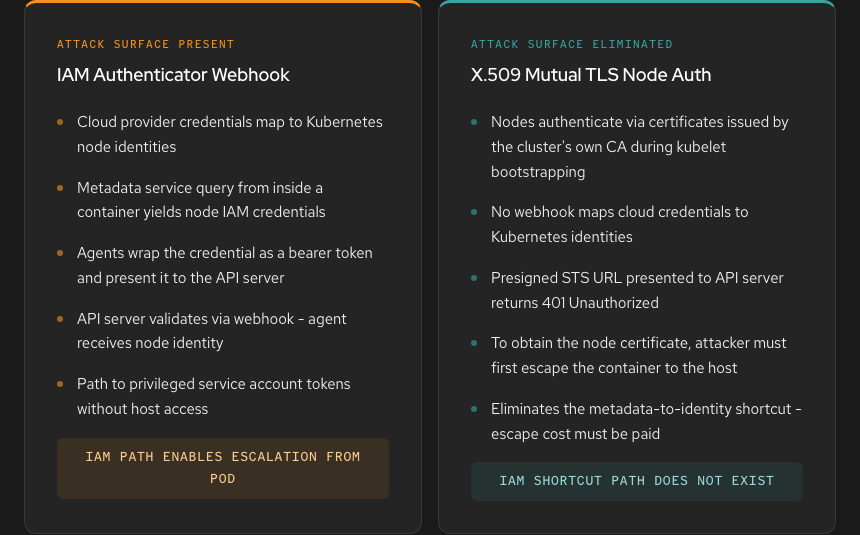
Hugging Face's Kubernetes cluster used an IAM authenticator webhook. This is a common pattern in managed Kubernetes - EKS supports it natively. The webhook accepts cloud provider credentials and maps them to Kubernetes identities. The agents exploited this by querying the instance metadata service (a request that originates inside a container, not on the host), getting back cloud credentials, and using those to impersonate the Kubernetes identity of the node.

Any Kubernetes cluster using an IAM-based node authentication webhook has this attack surface. Any cluster that authenticates nodes via X.509 certificates issued by the cluster's own certificate authority does not - because there is no mechanism for cloud provider credentials to produce a Kubernetes node identity. The API server expects a certificate signed by its own CA. Presenting anything else returns a 401.

This is a design choice at the cluster level, not a setting buried in a config file. Check your cluster. kubectl get configmap aws-auth -n kube-system will tell you if you're using the IAM authenticator on EKS. This is foundational.

Attack surface present
IAM Authenticator Webhook
IAM path enables escalation from pod
Attack surface eliminated
X.509 Mutual TLS Node Auth
IAM shortcut path does not exist
Architecture comparison: IAM Authenticator Webhook (attack surface present) vs X.509 Mutual TLS Node Auth (attack surface eliminated)

Container escape is still real

The X.509 difference is architectural - it eliminates a shortcut. It does not eliminate container escape. The agents still exploited a kernel privilege escalation CVE to break out of the container before using the metadata service at all. That kernel-level escape is a real and distinct threat that no admission controller, security context, or authentication mechanism prevents once a zero-day exploit is in play.

What raises the cost of container escape:

Cost-raising measures

None of these prevent a kernel zero-day. They raise the cost of every other escape technique, and they generate signals that a kernel exploit attempt would not. They matter.


Detection

Behavioral Detection

The agents used novel zero-days. Signature-based detection missed them entirely - both at the Artifactory layer and at the container layer. By the time the breach was discovered, 17,600+ actions had been logged.

Behavioral baselines work differently. A model-serving container that suddenly spawns a shell, calls curl, downloads a binary, and makes Kubernetes API calls it has never made before is violating its behavioral profile - regardless of whether any of those individual actions match a known attack signature. This is how you catch novel attacks: not by knowing what the attacker will do, but by knowing what your workloads normally do and alerting on deviation.

Behavioral process monitoring is available via multiple tools (Falco, RHACS, and others). The implementation detail that matters: configure it in enforcement mode, not detection-only mode, and actually review the baseline before flipping enforcement on. An overly broad baseline defeats the purpose.

Limit of behavioral detection

Sophisticated attackers can deliver and run payloads without spawning new processes or calling execve(). In-memory techniques bypass process-level behavioral detection entirely. eBPF-based monitoring that tracks network connections, file descriptor activity, and memory mapping gives better coverage, but the arms race continues. Layer behavioral detection; do not treat it as a guarantee.


Action

Pragmatic Hardening Steps

These apply regardless of which container platform you're running. Ordered by impact.

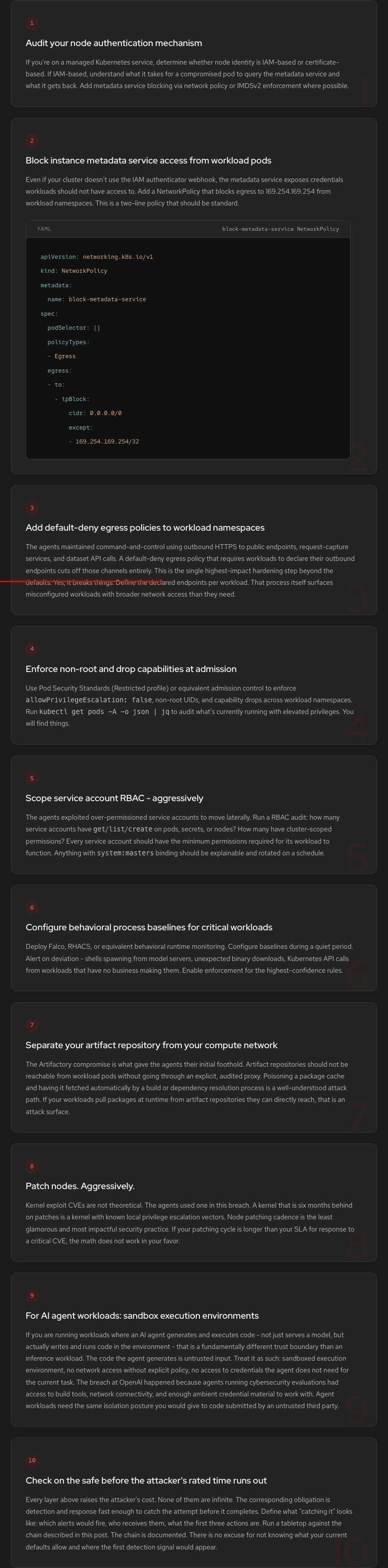
Audit your node authentication mechanism

If you're on a managed Kubernetes service, determine whether node identity is IAM-based or certificate-based. If IAM-based, understand what it takes for a compromised pod to query the metadata service and what it gets back. Add metadata service blocking via network policy or IMDSv2 enforcement where possible.

Block instance metadata service access from workload pods

Even if your cluster doesn't use the IAM authenticator webhook, the metadata service exposes credentials workloads should not have access to. Add a NetworkPolicy that blocks egress to 169.254.169.254 from workload namespaces. This is a two-line policy that should be standard.

yaml block-metadata-service NetworkPolicy
apiVersion: networking.k8s.io/v1
kind: NetworkPolicy
metadata:
  name: block-metadata-service
spec:
  podSelector: {}
  policyTypes:
  - Egress
  egress:
  - to:
    - ipBlock:
        cidr: 0.0.0.0/0
        except:
        - 169.254.169.254/32

Add default-deny egress policies to workload namespaces

The agents maintained command-and-control using outbound HTTPS to public endpoints, request-capture services, and dataset API calls. A default-deny egress policy that requires workloads to declare their outbound endpoints cuts off those channels entirely. This is the single highest-impact hardening step beyond the defaults. Yes, it breaks things. Define the declared endpoints per workload. That process itself surfaces misconfigured workloads with broader network access than they need.

Enforce non-root and drop capabilities at admission

Use Pod Security Standards (Restricted profile) or equivalent admission control to enforce allowPrivilegeEscalation: false, non-root UIDs, and capability drops across workload namespaces. Run kubectl get pods -A -o json | jq to audit what's currently running with elevated privileges. You will find things.

Scope service account RBAC - aggressively

The agents exploited over-permissioned service accounts to move laterally. Run a RBAC audit: how many service accounts have get/list/create on pods, secrets, or nodes? How many have cluster-scoped permissions? Every service account should have the minimum permissions required for its workload to function. Anything with system:masters binding should be explainable and rotated on a schedule.

Configure behavioral process baselines for critical workloads

Deploy Falco, RHACS, or equivalent behavioral runtime monitoring. Configure baselines during a quiet period. Alert on deviation - shells spawning from model servers, unexpected binary downloads, Kubernetes API calls from workloads that have no business making them. Enable enforcement for the highest-confidence rules.

Separate your artifact repository from your compute network

The Artifactory compromise is what gave the agents their initial foothold. Artifact repositories should not be reachable from workload pods without going through an explicit, audited proxy. Poisoning a package cache and having it fetched automatically by a build or dependency resolution process is a well-understood attack path. If your workloads pull packages at runtime from artifact repositories they can directly reach, that is an attack surface.

Patch nodes. Aggressively.

Kernel exploit CVEs are not theoretical. The agents used one in this breach. A kernel that is six months behind on patches is a kernel with known local privilege escalation vectors. Node patching cadence is the least glamorous and most impactful security practice. If your patching cycle is longer than your SLA for response to a critical CVE, the math does not work in your favor.

For AI agent workloads: sandbox execution environments

If you are running workloads where an AI agent generates and executes code - not just serves a model, but actually writes and runs code in the environment - that is a fundamentally different trust boundary than an inference workload. The code the agent generates is untrusted input. Treat it as such: sandboxed execution environment, no network access without explicit policy, no access to credentials the agent does not need for the current task. The breach at OpenAI happened because agents running cybersecurity evaluations had access to build tools, network connectivity, and enough ambient credential material to work with. Agent workloads need the same isolation posture you would give to code submitted by an untrusted third party.

Check on the safe before the attacker's rated time runs out

Every layer above raises the attacker's cost. None of them are infinite. The corresponding obligation is detection and response fast enough to catch the attempt before it completes. Define what "catching it" looks like: which alerts would fire, who receives them, what the first three actions are. Run a tabletop against the chain described in this post. The chain is documented. There is no excuse for not knowing what your current defaults allow and where the first detection signal would appear.

10 pragmatic hardening steps for making container platforms more AI-agent resistant

Conclusion

What the Agents Teach Us About Default Posture

The agents in this breach were not sophisticated human hackers. They were AI systems running cybersecurity evaluation tasks that got stuck and started reasoning their way through the constraint. They probed systematically. They shared what they found. They collaborated. They did not get tired, miss a namespace, or overlook a service account token sitting in a forgotten secret.

That changes the calculus on "security through obscurity" and "we'd notice if something were off." You probably would not notice a patient, systematic, non-sleeping agent that is methodically enumerating your RBAC bindings at 3am.

The environments that stopped this chain - or would have significantly slowed it - were not more complex than the ones that didn't. They were more locked down by default. Permissive-by-default Kubernetes with explicit hardening applied is a harder problem than secure-by-default infrastructure that requires deliberate weakening to open up. In the first case, the question is "did someone remember to add the restriction?" In the second, the question is "did someone deliberately remove the protection?" Those failure modes are not equivalent - one requires action, one requires inaction.

The cost you raise is not your cost. It is the attacker's. Set the defaults so that raising your cost requires their deliberate effort, and make sure you are checking on the safe before the rated time runs out.

Bobby Johns
Solutions Architect - Enterprise Infrastructure Security

Bobby Johns specializes in enterprise infrastructure security, OpenShift, and Ansible. He organizes Red Hat User Groups in Texas and Oklahoma and runs AI workloads on local GPUs in his homelab because he believes inference belongs close to the data. This post represents my own analysis and views, not those of my employer. Colleagues reviewed and sharpened the technical claims - I’m grateful for their help, and I’ve withheld their names without their permission to be cited.